
This post may contain affiliate links. Please read our disclosure policy.
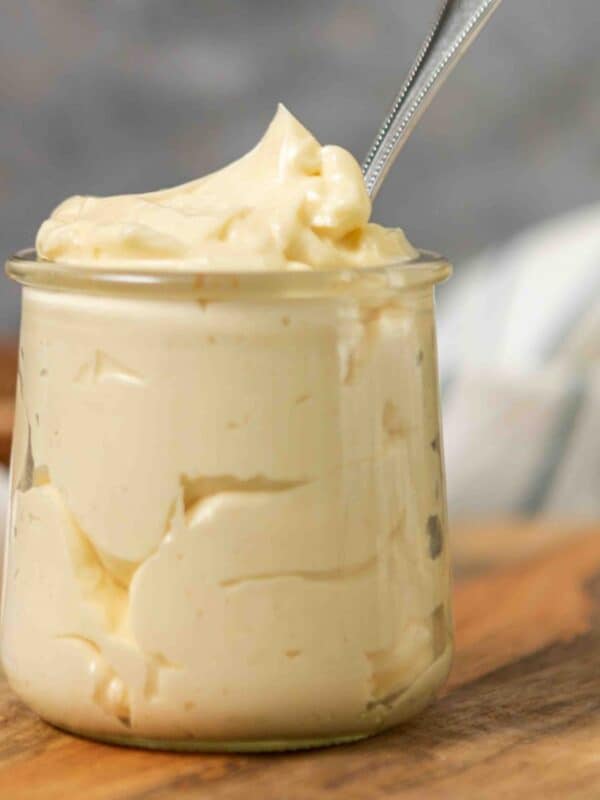
Homemade mayonnaise is the best! This recipe is easy and super quick, with less than 10 minutes of hands-on work. I can tell you you won’t go back to store-bought mayonnaise after trying this 5-ingredient mayo recipe!

I love mayo. I love it so much that when I was younger, my cousin and I would go to my grandmother’s house, take a slice of bread, spread mayo and ketchup on it, and eat it like a sandwich. Sure, I gotta admit I was a little bit of an overweight child, but what can you do when the love of food is so strong!
Now, looking back at our mayo sandwiches, I am a tad bit disturbed, but at the same time, I totally understand my younger self. After all, food is life!
Since I love mayonnaise so much, I wanted to share an easy recipe you can make at home for fun, or on those days when you really don’t want to go to the store for more.
Quick Look: Fail-Proof Homemade Mayonnaise
- 🥚 What it is: Creamy homemade mayo made with an egg, mustard, vinegar, and neutral oil in a food processor.
- ⭐ Why it works: Mustard helps the egg emulsify, and slowly adding the oil lets the mayo thicken without breaking.
- 💛 Why you’ll love it: No preservatives, and it turns into garlic aioli or sriracha mayo in seconds.
- ⚠️ What to watch for: Add the oil as slowly as possible at first, or the mayo won’t thicken.
- 🍳 Pan notes: Use a small food processor, or the small bowl attachment of a large one.
- ❄️ Make ahead: Keep it in the fridge, but don’t freeze it; thawing breaks the emulsion.
Table of Contents
- Quick Look: Fail-Proof Homemade Mayonnaise
- This is the homemade mayonnaise recipe you need to make your own today!
- Why This Recipe Works
- Ingredients to make homemade mayo
- What is the best oil to use for mayonnaise?
- Are raw eggs safe to eat?
- Step-by-step guide to make foolproof mayonnaise at home!
- Homemade mayonnaise variations
- Expert Tips
- Homemade Mayonnaise FAQs
- More Savory Recipe Favorites
- Homemade Mayonnaise Recipe
This is the homemade mayonnaise recipe you need to make your own today!
If you have never made your own mayo, don’t be scared. It is pretty easy to make and doesn’t contain all those preservatives that you would find in store-bought mayonnaise.
Now more than ever, with the extreme cold weather (yup, we went from 80F a few days ago to 35F this morning!), no one wants to leave the house, drive to the store, and wait in line just for a tub of mayo. So make it yourself at home, and you can thank me later!

Why This Recipe Works
Homemade mayo is a staple at my house, and this is exactly why we love it so much:
- You can make it in less than 10 minutes.
- It tastes fantastic, and you can adjust the flavor to your liking
- No processed ingredients! Yes please! By making this mayo at home, you can literally control everything that goes in it.
- It is super flavorful and fun to make.
Ingredients to make homemade mayo
To make your own mayonnaise at home, you will need the following ingredients:
- Egg– the egg is the base of this mayo. I use raw eggs to make my homemade mayo but if you’re concerned, feel free to use pasteurized eggs.
- Mustard– You will not taste the mustard much in the mayo, sure it does season the mayo a bit but it helps the mayo emulsify a whole lot more.
- Apple cider vinegar– The acidic nature of vinegar helps stabilize the mayo and gives it a little bit of a tang.
- Salt– Just a little salt to season the mayo
- Neutral flavored oil
- Lemon juice (optional)- Lemon juice adds a nice acidity to the mayo.

What is the best oil to use for mayonnaise?
The best oil you can use for mayonnaise is a neutral oil. I say neutral because mayo tends to have a soft, smooth flavor that isn’t too bitter.
A few neutral oils that you can use to make your homemade mayo are:
- Grape-seed oil
- Canola oil
- Sunflower oil
- Peanut oil
- Olive oil: with this one, just make sure that it is not extra virgin olive oil. Otherwise, your mayo will be too bitter.
Are raw eggs safe to eat?
According to the USDA, they are not. I, on the other hand, have never had an issue with that. I eat raw cookie dough and homemade mayo all the time with no problem whatsoever.
The risk of salmonella poisoning is so, so low; think 1 in 20,000 eggs have salmonella, so the odds are pretty low. Of course, use very good-quality eggs for this mayo recipe to ensure a healthy mayo.
On the other hand, you can also use pasteurized eggs to be 100% safe.
Step-by-step guide to make foolproof mayonnaise at home!
- In a small food processor, or using the small bowl attachment of your large food processor, add the egg, mustard, apple cider vinegar, and salt, then process for 30 seconds.
- Scrape down the sides of the food processor bowl, turn on the food processor again, and slowly start adding the oil. Go as slowly as possible to let the mayonnaise emulsify. Once the mayonnaise mixture starts to thicken a little more, you can add the oil a little faster.
- Wait 10 seconds after adding the last bit of oil, then turn off the food processor, scrape the sides, taste the mayo, add any salt or lemon juice to taste, and process for another 10 seconds.

Homemade mayonnaise variations
Honestly, you can take this mayo recipe and run wild with it. I have used it to make garlic aioli, spicy mayo, and so many other delicious sauces. A simple homemade mayo is also great as a creamy dip for crispy snacks like these air fryer polenta fries. It also works beautifully in creamy recipes like this tuna pasta salad.
- To make garlic aioli- Add one or two minced garlic cloves to the egg mixture to get a super flavorful sauce. You can also mix in a little homemade pesto for an easy herby sandwich spread.
- To make spicy sriracha mayo– Add 1-3 tsp of sriracha (or more if you’re feeling adventurous) after your mayo has thickened, then process for 10 seconds to combine everything together. If you love making sauces from scratch, you might also like this creamy garlic pizza sauce.
Expert Tips
- Let the egg come to room temperature. A cold egg straight from the fridge is harder to emulsify. Set it on the counter for 20 to 30 minutes before you start.
- Patience is a virtue with the oil. Start with just a few drops at a time, then switch to a thin, steady stream once the mixture starts to thicken. Rushing the oil is the number one reason homemade mayo turns out runny.
- Use the small bowl. In a big food processor bowl, the blade can barely reach a single egg, so the mayo struggles to come together. A mini food processor or the small bowl attachment makes it so much easier.
- Pick a neutral oil. Canola, grapeseed, sunflower, or a light olive oil all work great. Skip extra virgin olive oil, it makes the mayo taste bitter.
- Taste before you finish. Once it’s thick, give it a taste and adjust with a pinch of salt or a squeeze of lemon juice, then blend for 10 more seconds. No need to keep processing after that!
- Use pasteurized eggs for peace of mind. If you’re serving kids, older relatives, or anyone pregnant, pasteurized eggs give you the same creamy mayo without the worry.
- Put leftovers to work. Extra mayo is perfect for quick lunches like my 5-minute tuna sandwich, and it can even add moisture to baked recipes like these Jiffy cornbread hacks.
Homemade Mayonnaise FAQs
No. Freezing homemade mayonnaise breaks the emulsion, so once it thaws, you end up with a separated, oily mess instead of a creamy spread.
Store homemade mayonnaise in an airtight jar in the fridge and use it within about 1 week. Since it’s made with a raw egg and no preservatives, it won’t last as long as store-bought mayo.
Homemade mayonnaise usually stays runny when the oil goes in too fast for the emulsion to form. To fix it, add a fresh egg yolk to a clean food processor bowl, then slowly drizzle the runny mixture back in while it runs until it thickens.
I highly recommend it. You won’t taste much mustard in homemade mayonnaise, but it seasons it a little and helps the egg and oil emulsify so it thickens more easily.
Yes! Apple cider vinegar and white vinegar both work, and lemon juice is a great swap or addition if you want a brighter homemade mayonnaise. Add it a little at a time and taste as you go.
More Savory Recipe Favorites



If you tried this Homemade Mayonnaise Recipe or any other recipe on my blog, please leave a 🌟 star rating and let me know how it goes in the comments! I love hearing from you!
Homemade Mayonnaise Recipe
Equipment
Ingredients
- 1 large egg
- 1/2 tbsp mustard
- 1 tbsp apple cider vinegar or white vinegar
- 1/4 tsp salt
- 1 cup oil neutral flavored
Instructions
- In a small food processor or using the small bowl attachment of your large food processor, add the egg, the mustard, apple cider vinegar, and salt and process for 30 seconds.1 large egg, 1/2 tbsp mustard, 1 tbsp apple cider vinegar, 1/4 tsp salt
- Scrape down the sides of the food processor bowl, turn on the food processor again and slowly start adding the oil. You want to go as slow as possible to allow your mayonnaise to emulsify. Once the mayonnaise mixture start to thicken a little more, you can start adding your oil a little faster.1 cup oil
- Wait 10 seconds after adding the last bit of your oil, then turn off the food processor, scrape the sides, taste the mayo, and add any salt or lemon juice to taste and process for another 10 seconds.
Nutrition
Nutrition information is automatically calculated, so should only be used as an approximation.


Can I use a lot less oil to make a small batch? It is only for a recipe that I need the mayo and we don’t eat mayo often.
You can cut the ingredients in half to make a half batch.
Do you use processed mustard or powder?
I use regular processed mustard!
Do you use dry mustard for the recipe?
No I used a Dijon mustard for it.
I just googled it, and you can pasteurize eggs at home! One plugged says it takes about 3 minutes. That might be helpful to share with readers
Thank you so much for sharing this Lisa!
Chahinez
What if you don’t own a foodmixer?
Hi Vonnie,
You could try it in a blender if you have the possibility to slowly drizzle in the oil.
Chahinez