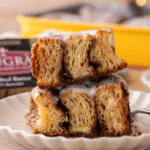
Croissant-Style Cinnamon Rolls (But Soft Inside)
Flaky, buttery croissant cinnamon rolls made with laminated dough and layered with cinnamon sugar, then baked until deeply golden and finished with a light cream cheese glaze. These rolls combine classic croissant technique with the comforting flavor of traditional cinnamon rolls.
Servings: 8 servings
Ingredients
Dough
- 400 g all-purpose flour Read notes
- 100 g bread flour
- 60 g granulated sugar
- 10 g fine sea salt
- 9 g instant yeast
- 310 g whole milk cold
- 30 g unsalted butter very soft
Butter Block
- 283 g 10 oz Plugrà unsalted butter cold but liable, cut into slices
Cinnamon Filling
- 160 g light brown sugar
- 12 g ground cinnamon
- 8 g cornstarch or all-purpose flour
- Pinch of salt
- 20 g unsalted butter melted (for brushing)
Vanilla Glaze
- 55 g cream cheese very soft
- 180 g powdered sugar
- 20 g milk or cream adjust for consistency
- 1 teaspoon vanilla extract or vanilla bean paste
- Pinch of salt
Instructions
Make the Dough
- In the bowl of a stand mixer, whisk together the all-purpose flour, bread flour, sugar, salt, and yeast.400 g all-purpose flour, 100 g bread flour, 60 g granulated sugar, 10 g fine sea salt, 9 g instant yeast
- Add the cold milk and soft butter.310 g whole milk, 30 g unsalted butter
- Mix on low speed for 3–4 minutes until a shaggy dough forms.
- Increase to medium-low speed and mix another 3–4 minutes until smooth and elastic. The dough should be soft but not sticky.
- Shape into a rectangle about 1 inch thick, wrap tightly, and refrigerate for 30–45 minutes.
Prepare the Butter Block
- On a sheet of parchment paper, draw a 7 × 8-inch rectangle using a ruler and marker. Flip the parchment over so the ink side is facing down (this prevents ink transfer).283 g 10 oz Plugrà unsalted butter
- Put the cold but pliable butter slices in the center of the drawn rectangle on the clean side of the parchment. It’s okay if it doesn’t fill the shape yet. Place a second piece of parchment on top. Using a rolling pin, gently pound the butter to start flattening it. This softens it evenly without warming it too much.
- After pounding, begin rolling the butter outward toward the corners of the rectangle, using the drawn lines as your guide. Keep the edges as straight as possible.
- If needed, lift the parchment and use a bench scraper or your hands to press and straighten the sides so you end up with a neat, even 7 × 8-inch rectangle of consistent thickness.
- Refrigerate the butter block until it is cold but still bendable. It should feel firm, but if you flex it gently, it shouldn’t crack. If it’s rock hard, let it sit at room temperature for 3–5 minutes before laminating.
Laminate the Dough
- Roll the chilled dough on a lightly floured surface into an 8 × 16-inch rectangle. Keep the edges straight and thickness even. If the dough resists or shrinks back, let it rest 5–10 minutes before continuing
First Fold
- Place the butter block in the center of the dough so it covers half the rectangle. Fold the dough over the butter to fully enclose it, aligning edges carefully. Pinch the seams closed and press gently to seal so no butter is exposed.
- Fold into thirds like a letter. Fold the top third down, then fold the bottom third up over it. This completes the first fold. Wrap tightly in plastic wrap and refrigerate for 30 minutes to firm the butter and relax the gluten
Second Fold
- Rotate the dough 90 degrees (so the folded edge is on your left like a book spine). Roll again into a 10 × 20-inch rectangle, keeping the thickness even and edges straight. If the dough springs back, chill 10–15 minutes before rolling further.
- Fold into thirds again. Wrap tightly and refrigerate for 30–40 minutes. The dough should feel cool and slightly firm before continuing.
Gentle Third Fold
- Roll slightly thicker into an 8 × 15-inch rectangle for the final fold. Handle gently and avoid excessive pressure to preserve the layers.
- Fold into thirds one last time. Wrap tightly and refrigerate for 45–60 minutes before rolling out to add the filling and shape the cinnam
Make the Filling
- In a medium bowl, mix the brown sugar, cinnamon, cornstarch (or flour), and a pinch of salt until evenly combined. Set aside.160 g light brown sugar, 12 g ground cinnamon, 8 g cornstarch or all-purpose flour, Pinch of salt
Shape the Cinnamon Rolls
- Roll out the dough: On a lightly floured surface, roll the chilled laminated dough into a 14 × 16-inch rectangle, about ¼-inch thick. Try to keep the thickness even so the rolls bake uniformly.
- Lightly brush the surface of the dough with melted butter (optional but recommended for richer flavor and better filling adhesion).20 g unsalted butter
- Sprinkle the cinnamon sugar mixture evenly over the dough, leaving about ½ inch bare along one long edge to help the seam seal. Lightly press the filling into the dough with your hands or a rolling pin (very gently) so it adheres to the melted butter and doesn’t spill out as much while rolling and slicing.
- Starting from the longer side, roll the dough up into a tight log. Roll steadily but gently, tight enough to create defined swirls, but not so tight that the filling squeezes out.
- Finish with the seam on the bottom of the log and gently press to seal. (Keeping the seam underneath helps prevent the rolls from unrolling during proofing and baking.)
- Trim a thin slice off each end to clean up the edges, then cut into 8 even rolls.Easiest method: Use a very sharp knife and gently slice your rolls.Optional: You can use a pizza cutter to cut the log into sections first, but it can be messier because some filling may slide out.
Proof (timing depends on your kitchen)
- Arrange rolls in a parchment-lined 9 × 13-inch pan, spaced evenly. Place each roll so the loose end (“tail”) is pointing towards another roll (not sticking outward). This helps keep the spiral tight so they don’t open up too much while proofing/baking.
- Cover loosely and proof until noticeably puffy and the rolls are just touching or nearly touching.In a cool kitchen (around 70°F): about 1½–2 hoursIn a warm kitchen: proofing may be faster.Visual cue matters most: They should look lighter, inflated, and jiggly when you gently shake the pan.
- Once proofed, place the pan in the refrigerator for 15–20 minutes while the oven preheats. This firms the butter layers again and helps the rolls bake up flakier with cleaner layers.
Bake
- Preheat oven to 400°F. Bake for 10 minutes, then reduce the oven temperature to 375°F and bake 15–20 minutes more, until deeply golden and baked through.
- Let the rolls cool in the pan for 10 minutes before glazing so the glaze melts slightly but doesn’t disappear completely.
Make the Glaze
- Beat the softened cream cheese until completely smooth. Add powdered sugar, vanilla, and a pinch of salt and mix until smooth.55 g cream cheese, 180 g powdered sugar, 1 teaspoon vanilla extract or vanilla bean paste, Pinch of salt
- Whisk in milk or cream a little at a time until the glaze is thin and pourable (a thin glaze keeps the flaky layers visible).20 g milk or cream
- Drizzle glaze over warm rolls and serve immediately.
Video
Notes
Quick Troubleshooting
- If butter cracks/breaks through: It’s too cold, let dough sit 5 minutes, then continue rolling gently.
- If dough feels soft/greasy: Butter is warming, refrigerate dough 10–15 minutes before continuing.
- Best proofing spot: A turned-off oven with the light on works well for a gentle warm proof, just watch the dough so the butter doesn’t melt.
- If filling spills out while slicing: Just sprinkle any fallen filling over the tops before proofing, still delicious.
Nutrition
Calories: 776Calories | Carbohydrates: 102g | Protein: 9g | Fat: 38g | Saturated Fat: 24g | Polyunsaturated Fat: 2g | Monounsaturated Fat: 10g | Trans Fat: 1g | Cholesterol: 101mg | Sodium: 757mg | Potassium: 188mg | Fiber: 3g | Sugar: 51g | Vitamin A: 1200IU | Vitamin C: 0.1mg | Calcium: 106mg | Iron: 3mg
